
Ethernet devices have changed considerably in both size and capability over the past decade. Network interface cards, switches, routers, and IoT hardware are expected to support a wider range of data rates while fitting into smaller enclosures than before, a trend that has direct consequences for the magnetic components sitting between each device’s PHY chip and its cabling. The LAN transformer, once available mainly in bulkier discrete forms, has adapted alongside this shift toward more compact and integrated network hardware.
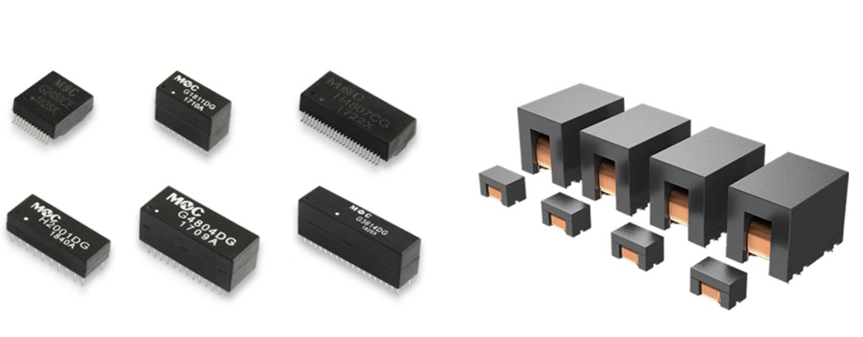
The Shift Toward Smaller, More Integrated Network Devices
Modern network equipment increasingly needs to support multiple Ethernet standards, from 10/100/1000M BASE-T up through 2.5G, 5G, and 10G BASE-T, while occupying less board space than earlier generations of hardware. This has placed pressure on component manufacturers to offer magnetic solutions that maintain signal integrity and isolation performance without demanding the same footprint that older, bulkier transformer designs required. At the same time, devices ranging from enterprise switches to small IoT sensors continue to rely on the same underlying transformer functions, signal conditioning, isolation, and impedance matching, even as the physical form those functions take on has continued to change.
Traditional LAN Transformers: An Established Foundation
Traditional LAN transformers, built around a toroidal core, remain a well-established option for network equipment that can accommodate a larger component footprint. Mentech’s traditional LAN transformer line is available in single-port, dual-port, and quad-port configurations, complies with IEEE 802.3 and ANSI X3.263 standards, and supports maximum data rates up to 10G.
It also offers HDBaseT-compatible isolation surge protection up to 6KV and Power over Ethernet support up to 150W, with certain variants suited to automotive applications where higher isolation and power delivery requirements are common.
Chip LAN Transformers: Meeting the Demand for Compact Design
As board space has become more constrained, chip LAN transformers have taken on a larger role in network equipment design. Using a chip-based core rather than a toroidal one, Mentech’s chip LAN transformer products are manufactured through fully automated equipment, supporting data rates up to 10G under IEEE 802.3, with Power over Ethernet capability up to 90W and an operating temperature range of -40°C to +85°C.
Their smaller size and low power consumption make them a better fit for compact, high-density PCB layouts common in embedded systems and IoT devices, where every millimeter of board space carries added value.
Comparing Packaging and PCB Space Considerations
The packaging difference between these two transformer types reflects more than a simple size reduction. Traditional LAN transformers, manufactured with more manual assembly involved, generally suit equipment where component density is less of a constraint, such as larger networking chassis or industrial installations.
Chip LAN transformers, by contrast, are produced on fully automated equipment, which reduces manual operations, shortens production cycles, and supports the tighter component placement tolerances needed in high-density PCB designs. This automated production approach also contributes to more standardized output across manufacturing runs, an important consideration for device makers producing network equipment at scale.
Mentech notes that this shift toward automated chip transformer production also supports shorter delivery times and more stable quality compared with the largely manual processes historically associated with discrete network transformer manufacturing.
Matching Transformer Type to Device Category
Given these differences, the choice between a traditional and a chip LAN transformer often follows the category of device being designed. According to Mentech’s product positioning, chip LAN transformers are commonly applied in network interface cards, switches, and routers, where compact size and low power consumption support efficient data transmission, as well as in IoT and smart devices where a smaller form factor is a defining design constraint.
Traditional LAN transformers remain more common in equipment where higher isolation surge protection or greater POE power delivery is required, including industrial and automotive networking applications, since these use cases benefit from the higher power and isolation ratings traditional constructions can support.
Mentech’s Communication Magnetics Lineup and Development Capabilities
As outlined on Mentech’s own lan transformer product information, the company maintains both traditional and chip LAN transformer product lines within its broader telecom magnetic components category, giving network equipment manufacturers a choice between established discrete designs and more compact, automated-production alternatives depending on the specific device being developed.
This dual product structure reflects the reality that no single transformer format suits every category of Ethernet hardware, from large industrial switches to compact IoT sensors.
Mentech, a transformer and inductor manufacturer, positions its communication magnetics portfolio to serve network equipment manufacturers across this range of device types, offering both standard catalog transformers and development support for projects requiring parameters outside its existing product range.
For manufacturers navigating the ongoing shift toward smaller, higher-speed network devices, this kind of product breadth provides a practical starting point when comparing transformer options against a specific device’s isolation, power, and space requirements.
Closing Perspective
The move toward more compact, integrated Ethernet hardware has not eliminated the need for traditional LAN transformer designs, but it has expanded the range of options available to device manufacturers. Traditional and chip LAN transformers each address a different combination of isolation, power delivery, and footprint requirements, and understanding where each fits allows network equipment designers to match component selection to the specific demands of the device category they are developing, rather than defaulting to a single transformer format across every product line.